 |
 |
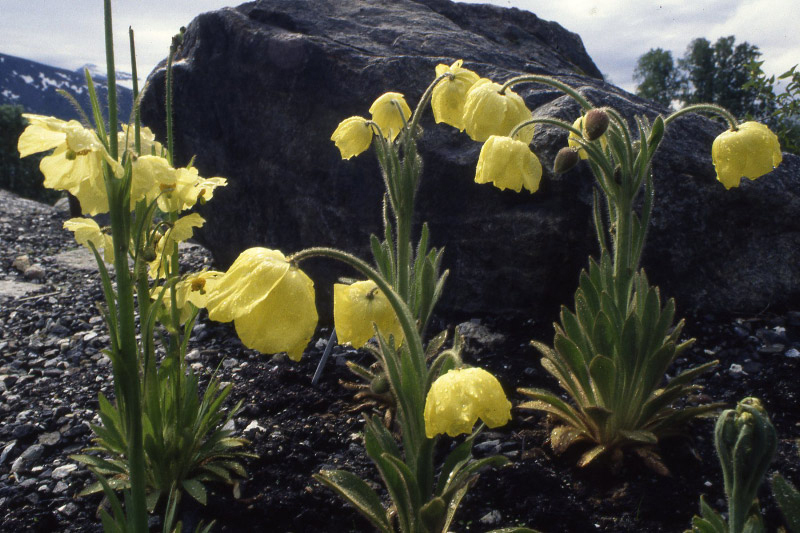
| Note these species are not entirely deciduous and some rosette is visible over winter and they are monocarpic (they die after flowering). They were recently split into 2 species with 5 sub species. M integrifolia (above) has big deep yellow upright flowers, no style with the stigma directly on the ovary and 3 veined leaves.The other is M. pseudointegrifolia which is the next image. Few images show all these features and anyway, as we shall see they are not really consistent. Ref New Plantsman, 3 (1) 1996 - Chris Grey-Wilson. | The opposite extreme, M. pseudointegrifolia. This shows cream flowers that droop, a really long style behind the stigma above the ovary and leaf veining that is rather random. These characteristics are most common at lower levels - 3,500 metres where the plants often grow though vegetation and they grow in the wetter western part of the range of this pair of species. |
 |
 |
| The two species growing together in cultivation in Norway by Finn Haugli. The single plant on the left is M. pseudointegrifolia This does show the difference between the stigma and the ovary. The leaf details are not visible and the large globe like flowers of M. integrifolia are drooping in the rain. The flower colour is very similar. To some extent this image illustrates the difficulty in separating these species. | The second image on this page was taken by the author about 600M. lower than this one on the Da Xu Shan in NW Yunnan. Tall flowering specimens occurred in scrubby vegetation where domestic animals had been brought for summer grazing. As one ascended a sharp steep scree the plants become dwarfer and in particular the mid-rib of the leaf became progressively thicker but did not become 3 ribbed. The plant clearly adapting by producing more compact and robust leaves at higher levels of exposure to wind. The Da Zue Shan is about the area where Chris Grey-Wilson describes the separation of M. integrifolia from M. pseudointegrifolia. |
 |
 |
| The next 3 images from the garden illustrate the huge variation in this pair of species. A newly emerging rosette from winter dormancy. Some of these can be compact plants with soft overtones of pink or even a bluish tinge. From a single locality the plants will be similar as were garden collected seeds 40 years ago. Since then the species has been split into two and there is much variation in form and size between the two species in different localities. | The form in cultivation 40 years ago. This image was taken in the St. Andrews Botanic garden. This was in a nutrient poor peat bed, and they flowered 2 years after sowing. The flowers were typical deep yellow and globe shaped. Leaf veination was not recorded. |
 |
 |
| From the same seed source as the plants in the previous image but grown in rich garden soil. THIS MAKES A VERY IMPORTANT POINT WHEN TRYING TO IDENTIFY MANY MECONOPSIS SPECIES, the behaviour of many species in the garden is significantly different from the wild and as these two images show the fertility of the soil has considerable effects. | Typical seed pods of M. integrifolia. This lacks almost any style between the stigma and ovary and is almost reverting back to the position of plants in the genus Papaver (like some M. betonicifolia within Meconopsis) This lack of style is one feature used by C. Grey-Wilson in his new classification splitting the old M. integrifolia into two species. It should be noted however that style length is variable even within the new definition of M integrifolia. |
 |
 |
| A long narrow style between the narrow seed pod and the rounded stigma characteristic of M. pseudointegrifolia. The plants are typical of lower altitudes in wet areas of China and Tibet. They are generally easier to grow in the garden than higher altitude plants that more resemble M. integrifolia. Mainly for this reason and the fact that Meconopsis in general are more difficult to grow in the drier, hotter summer climate of the U.K of the last few decades has seen this form become dominant and the rather more spectacular M. integrifolia types quite rare. Image Hilary Birks - Shika Shan 2009. | Leaves of second year plants grown from wild collected seed. All these were purchased as M. integrifolia. The leaf veination tends towards being 3 veined but in none of them is it clear cut. Some M. integrifolia from places like Qinghai do have unequivocal 3 veined leaves and many M. pseuodointegrifolia from lower levels in N.W. Yunnan and Tibet show leaves with a completely random leaf veination. |
 |
 |
| Map of the western borders of China with Tibet, Assam and Burma. This is directly taken from the map of this region by Dr. Chris Grey-Wilson to show the distibution of the species and sub-species of M. integrifolia and M. pseudointegrifolia according to his recent re-classification (see ref. first image this page). The webmaster accepts this classification but clearly there is huge variation in this pair of species and the key features are so variable that many plants in the garden and the wild are difficult to assign with certainty. Visitors to botanically unexplored parts of this region of the world will undoubtedly find further variation. C. Grey-Wilson in a talk to the Meconopsis Group in Edinburgh discussed the concept of 'Species Associations' of closely related taxa sharing characters. For many both in the garden and the wild it might be best to live with this concept of 'super species'. | Meconopsis x Harleyana. This was first found by Frank Kingdom Ward in the Temo La in Tibet but had in fact first been described as a garden Hybrid between M. integrifolia and M. simplicifolia by Andrew Harley. Taylor suspected this was a wild hybrid. Taylor was excited to confirm his suspicions in 1938 when accompanying Frank Ludlow to the Sang La and found numbers of this hybrid among colonies of M. integrifolia (would now be M. pseudointegrifolia ssp. robusta) and M. simplicifolia. It is always cream or white but maybe with a touch of blue at the centre of the flower. When Taylor later returned for seed the hybrid proved sterile. As we shall see M. integrifolia /pseudointegrifolia is involved in many exellent hybrids with blue flowered species always creating cream coloured progeny. Except for possibly a plant of M. x Beamishii (see later) this is so far the only hybrid found in the wild. |
 |
 |
| M. x Finlayorum. A beautiful hybrid between M. integrifolia and M. quintuplinervia which is perennial. This cross was made by the webmaster (and others) and is now lost. It was named after the Knox-Finlay's of Keillour who made the original cross. Well worth repeating as it is dwarf and highly attractive. | The relationship with M. integrifolia shows here. This is M.x Beamishii with M. grandis as the other parent. A small proportion of these from seed are perennial and the hybrid is fertile. They make a good garden plant and are totally deciduous. There is a single report of this in the wild. This can be told from the following species (M. x Sarsonsii) by the leaf which looks like that of M. grandis - but I will not pretend that is easy! |
 |
 |
| M.x Sarsonsii - a garden hybrid between M. integrifolia and M. betonicifolia. Like M. x Beamishii told by the leaves which in this case resemble M. betonicifolia. Again totally deciduous, fertile and again a small percentage from seed are perennial. Another really nice garden plant, not recorded from the wiid but possible. | This is a very critical image in two ways. It is the yellow form of M. discigera. First found in west Sikkim in 1905 and described by Praiin as yellow, though he later withdrew this. Described in 1923 from Nepal as crimson, red or purple and as blue from Bhutan. The blue form is illustrated on the appropriate page of the website. The only difference I can see from images and growing the yellow form is that the tips of the leaves in the yellow form are 3 lobed and the blue form 5 lobed. I have always doubted they were the same species, however similar, BUT strongly suspect sometime in the evolutionary past the yellow form arose as a hybrid probably between M integrifolia and the blue M. discigera. This might well show up in genetic analysis. |
 |
|
| There are other yellow deciduous Meconopsis that may also be either fixed ancient hybrids (now true species) or current hybrids (like M.x Harleyana - see above). The image above is the type specimen of M. georgei (named after George Forrest) and collected on the Fu-chuan Shan in N.W. Yunnan by Forrest (later by Rock). It resembles spiny forms of M. horridula except it is yellow flowered. Yellow M. horridula was found in small numbers by Sherriff on the Shagam La near Tsari in Tibet but later in numbers on the Mira La (growing with masses of short stalked M.integrifolia). Taylor desribed M. florindae - a Kingdom Ward find- rare and only known from the Tra La in south east Tibet and related to the blue M.lyrata. Yellow forms of normally blue species may have hybridised (mainly with M. integrifolia) and this needs genetical investigation to establish their true status. | TO SUMMARISE M. integrifolia and M. pseudointegrifolia are very widespread and variable. They hybridize with other species in the wild and much more readily in the garden and the progeny tend to resemble the other parent. IT SEEMS POSSIBLE, IN THE WILD, THAT IN THE PAST BLUE AND YELLOW SPECIES HAVE HYBRIDISED TO PRODUCE NEW LARGELY PALE YELLOW SPECIES. If M. discigera in the distant past was a fertile viable hybrid of the blue form of this species with - perhaps- M. integrifolia, it is worth noting that this took place between members of different subgenera - EUMECONOPSIS and DISCOGYNE. |
 |
|
| There is a particular reason for including a pink poppy. This lovely image of M. sherriffii was taken in Bhutan by Martin Walsh. Joseph Rock the American collector who was resident in China for many years mentioned a pink M. intregrifolia he had found. I am pretty sure he never went to Bhutan where this species was found on a Ludlow and Sherriff expedition as well as in nearby Tibet. However the Japanese photograher Eiko Chiba shows an image of this species taken near Kanding in Sichuan, hundreds of miles from Bhutan. It is possible that this species was moved from Bhutan as the webmaster has proposed to account for M. betonicifolia in Yunnan hundreds of miles from the Tibet sites. It is possible that both Rock's and Chiba's plants were hybrids between M. punicea and integrifolia though the webmaster has failed to get this cross to take many times. The Kanding site has been travelled past by western botanists many times recently so is undoubtedly rare there. |

Saturday, 7 January 2006
Deciduous - Yellow
Friday, 6 January 2006
Big Blue - Deciduos
 |  |
| M. grandis seed pods. This species has recently been the subject of a long and fascinating paper by Chris Grey-Wilson (with a cultivation account by John Mitchell of the RBGE) in SIBBALDIA 8. He recognises ssp. jumlaensis - a dwarf outlying population isolated in West Nepal near Jumla, ssp. grandis - east Nepal especially south and east of Everest and M.g. orientalis from north and east Bhutan, adjacent Indian territory and adjacent Tibet. This last is the one commonly in cultivation and includes the famous L and S 600. | Absolutely superb image of Meconopsis betonicifolia (This would now be M. baileyi if you accept the new classification of Chris Grey- Wilson -which the webmaster does not). This from the Rong Chu in Tibet. It is variable in the wild especially as regards stigma length which can be non-existant or several millemetres. The flowers are smaller than M. grandis (next image) BUT the defining characteristic is the betony like leaf shape with neat indentations down the leaf. |
 |  |
| Garden image of M. grandis. This again is a very variable plant ususally easy to distinguish from M. betonicifolia from leaf shape BUT very easily confused with the many hybrids between these two species. This normally has white filaments to the anthers. | M. simplicifolia. THIS HAS 2 DISTINGUISHING CHARACTERS -Blue filaments to the anthers and it is always scapose. This species like the previous two can often be purple flowered. This colour can be attractive or rather 'washy'. The leaves are simple strap-shaped but the plant is very variable to big robust specimens that can be perennial to small delicate plants that may always be monocarpic. There used to be in cultivation an exquisite brilliant blue form that was monocarpic but it has been lost for many years. In the wild a particular population is consistent to size and other chracteristics. I suspect like many of this genera lower altitude plants may be easier in cultivation although this species has never been common even in Scottish gardens. Wonderful image by Margaret Thorne in Bhutan |
 |  |
| Another critical image. Meconopsis LINGHOLM. This is an exceptional poppy which first appeared in a garden in the Lake District of England many years ago. It arose from a fertile seed pod on the normally sterile M. x Sheldonii - so is technically a form of x. Sheldonii. This in turn is a hybrid made a number of times between M. betonicifolia and M. grandis (called M. x Sheldonii after the man who made the first cross). The progeny were sterile since the latter has twice the chromosome number of the former. Research has shown Lingholm has double that number of chromosomes and is now fertile. | Meconopsis betonicifolia. Readers should be aware that this species has recently been split by Dr. Grey-Wilson (Bulletin of the Alpine Garden Society, vol.77,no 2 June 2009). This is a garden image. The leaf to the left shows the classic betony shape. The outlying Yunnan population is now called M. betonicifolia and the Tibet population is M. baileyi. Grey-Wilson lists 9 differences. 3 of these are based on leaf dimensions where there is overlap in herbarium measurements but much more variance when garden plants are measured. Yunnan plants are stoloniferous BUT so are some forms in cultivation. The Yunnan plant flowers without a leaf whorl but the images in the wild and many plants in gardens will also show flowers without a leaf whorl. The style length, stigma length and capsule size are much more variable in the wild and gardens than Grey-Wilson states. |
 |  |
| Beautiful wild image of M. betonicifolia in Tibet. Typical foliage, flowering from a stem leaf rosette and typical flower at very best. In Tibet flowers range from having no style (like a true Papaver) to at least up to 6mm. It appears that different areas in this region have plants that though consistent to area, are very variable in many flower and capsule characteristics. There are wild images from this region (unlike this plant) where flowers are borne from the upper leaves of simple stems with no upper rosette and plants like this regularly occur from seed (especially weakly growing ones) . Since Kenneth Cox brought back new seed from this region of this species there is much more variation in garden populations especially as regard to style and stigma measurements. As far as I am aware nearly all the plants from this collection were monocarpic but they arrived during three years with hot summers. | This is in a way a critical image in the argument about 1 species or two. The left leaf is the hairy seed pod of the Tibetan form of M. betonicifolia (the other is the hybrid Lingholm).[The style on this specimen is more than 6mm. long BUT some, especially those in cultivation for many years can have no style at all] Taylor 70 odd years ago acknowledged capsule hair differences between the two populations, but even here claimed among herbarium specimens of the Tibet form some were virtually hairless and some of the Yunnan form did have sparse hairs. M. punicea, M. quintuplinervia and M. grandis are all reported to have hairless ovaries in some collections. It seems a trivial character to separate two species. TO ME IT MUST BE AT LEAST LIKELY THAT THIS WAS AN EASILY PROPAGATED form that was taken down the trade route from Tibet through Yunnan and established there. Remember there is evidence that some populations of M. grandis are closely associated with settlements, past or present and both species were clearly of great economic significance for oils and/or as medical herbs. |
 |  |
| This is an image from Geoff Hill of what is known as M. betonicifolia forma pratensis. This was originally found in North Burma by Frank Kingdom-Ward and described in 1927. I grew this 40 years ago and it was a tall straggling plant with clear close affinities to M. betonicifolia. It was sterile. It is by no means clear if this plant or the ones I used to grow were in fact derived from Kingdom-Wards or why they became sterile. | The leaf of M.b. forma pratensis from Geoff Hill. Different but with obvious similarities to the species. |
 |  |
| Seed capsule of the pratensis form from Geoff Hill with a long style and large stigma, the capsule shape is typical M. betonicifolia. | The leaf of M.b. pratensis, again from Geoff Hill. The purple colour and to some extent the leaf shape are more typical of the L and S 600 form of M. grandis - see later pictures this section. |
 |  |
| An image from John Mitchell of the Royal Botanic Gardens in Edinburgh taken in one of the well known locations for M. betonicifolia. This plant looks to be without an upper rosette but close examination will show both plants have lost the top of the flower. If I had been confronted with this plant 'blind', I would have guessed M. grandis as the leaf is really not typical of M. betonicifolia and the flowers are large. Clearly shows how variable this taxon is in the wild and that the ones we grew for many years in the garden were consistent with smaller cup-shaped flowers and stigma flat on the ovary. | Another group of M. betonicifolia in SE Tibet taken by John Mitchell of the RBG Edinburgh. Some of these are quite different to images 2 and 7 on this page of robust individual plants. Careful examination of this picture shows plants that have no significant upper rosette. |
 |  |
| This is a form of M. betonicifolia grown from seed collected in Assam. An almost white form. A white form has existed in cultivation for many years and breeds true and is interesting in that it has no style at all - unlike the plant illustrated. | SLIEVE DONARD In my judgement the most beautiful of all big blue poppies. This is a form of M. x. sheldonii (M. betonicifolia x M. grandis) Alex Cross made this cross in Edinburgh. He made Ormswell at the same time. Slieve Donard was sent to Ireland and after various name changes became Slieve Donard after the nursery (and mountain!) of that name. It is still a reliable and robust grower and very perennial. It is currently available in the specialist U.K. trade. Growing here at the wonderful woodland gardens at Glendoick - home of 3 generations of the Cox family of Himalayan plant hunters and Rhododendron specialists. |
 |  |
| A really beautiful form of M. x Sheldonii which the webmaster had for many years of unknown origin. Evelyn Stevens has renamed many of the big blue poppies both those fertile and infertile probable hybrids. This plant is possibly the one she has named Bryan Conway. Many big blue poppies are described by Evelyn Stevens on the meconopsis group website. | A form of M. grandis in the rhododendrons at Glendoick - the home of the Cox family. This garden is open in early summer and tickets for entry can be purchased from the garden centre at the edge of the main road. This species is not always easy from seed primarily because established plants do not always set very much seed. It is nice to have the true species but in fact the hybrid Lingholm is much more easily obtained and better than many forms of true M. grandis. |
 |  |
| Many Meconopsis have characteristic spring foliage and this is the distintive emergence of GS. 600. NOW THIS HAS BEEN WRONGLY NAMED for all my time with Meconopsis it should be L and S 600. Ludlow and Sherriff described this in Bhutan before the second world war. It admittedly was found by Sherriff. It is a very mysterious plant since for 50 years anyway it has been totally sterile. There are many clones of this and all are beautiful and very perennial and easily vegetatively propagated. A great many of these have been collected and named in Scotland by Evelyn Stevens and many are illustrated on the Meconopsis Group website. The webmaster has to confess that many of the sterile big blue poppies currently in existance, most look much the same, the same clones differ as to where cultivated and I cannot tell them apart! | This is my clone of L and S 600 I was given more than 40 years ago from a garden in St. Andrews and now thriving in Wick, Caithness. This typically shows a touch of mauve in the flower but this varies between sites and seasons. It must have been fertile when collected since many clones were grown from the introduction. It was claimed to be fertile in the 1950s'. However all L and S 600 clones now have hairy seed pods and M. grandis from this area of Bhutan would not and it must have hybridized - which accounts for the sterility. Arguments continue to rage about this remarkable plant and recent expeditions to Bhutan on the Me La have found very similar plants. |
 |  |
| Another M. grandis grown from seed of the PSW expedition and in the garden of Ian Scott in Gauldry overlooking the Tay in Fife. | SUMMARY - IF YOU HAVE A BLUE POPPY YOU WISH TO IDENTIFY - DOES IT SET SEED? At the back is a true M. grandis and the foreground is Kingsbarns hybrid -a fertile allopolyploid of M. x Sheldonii and has the same origin as Lingholm - this last is far and away the most likely plant that you will have. These all have large seeds. You need to eliminate M. betonicifolia (characteristic leaf - image 6 this page - as well as a small seed, less than half the size of M. grandis and the fertile big blues.) |
 |  |
| There are white forms of big blues in cultivation. M. betonicifolia has a crystalline white form - true from seed. All the others I have ever seen - bar one many years ago - are actually a pale cream (see the image of M.x Harleyana).The plant illustrated came from a batch of Lingholm seed and is one of five I have had from this source. I strongly suspect they are complex hybrids with M. integrifolia /pseudointegrifolia. | SUMMARY - IF IT DOES NOT SET SEED This plant is named Mrs Jebbs after a Scottish gardener from Crocketford many years ago. It is probably the same cross as M. x Sheldonii. It is however rather different, much more closely resembling M. betonicifolia than M. grandis with smaller cup shaped flowers but always a good clear light blue. Many of these sterile cultivars, propagated vegetively, are described on the Meconopsis Group's website. Some gardens have collections of them - notably Branklyn in Perth so excellently run by Steve Macnamara. THE WEBMASTER MUST CONFESS THAT OTHER THAN A FEW VERY DISTINCTIVE CULTIVARS THEY TEND TO ALL LOOK ALIKE TO HIM. THERE ARE MINOR BUT PROBABLY CONSISTENT DIFFERENCES. THE RHS IS CURRENTLY GIVING AWARDS TO A SELECTION OF THESE STERILE HYBRIDS. I certainly cannot tell many of them apart and there is perhaps only one grower who can!! I suspect that that over time the names in commerce will become suspect. |
Thursday, 5 January 2006
Discogyne - Disk On Flower
 |
 |
| Meconopsis discigera Slightly dark image of a flower of M.discigera that has shed it's petals. Meconopsis have a sub-genus called Discogyne. When Sir George Taylor wrote his book and this classification there were just 2 species in the sub-genus. M. torquata and M. discigera (the colour of which caused him confusion). This is the blue form from Bhutan (but see later on this page) THIS GROUP OF PLANTS DIFFER FROM ALL THE OTHERS which are placed in the sub-genus Eumeconopsis. THEY ARE DISTINGUISED BY A DISC BETWEEN THE HAIRY OVARY(seed pod) and the STYLE (the stem like bit) and the STIGMA at the tip which collects the pollen and allows the pollen tube to grow down through the style to fertilise the embryo seeds in the ovary. Margaret Thorne image |
This is the blue form found in Burma. There is some confusion with this species. Taylor split this and M. torquata off in his monograph based on the disc above the ovary through which protrudes the style and stigma into a new sub genera the Discogyne. This was first described by Prain in 1906 as having yellow flowers but in a 1923 publication changed his mind. Taylor described the colour as crimson red, red, purple or pale blue. They were flowered at Edinburgh in 1923 and later BUT they flowered yellow!! Margaret Thorne images of the blue form. |
 |
 |
| The leaf of the blue Bhutan form. The leaf appears always to be five lobed and thuis should be compared with the yellow form (later images) which has only 3. | The yellow form found in Nepal and Sikkim and occasionally flowered in Scottish Gardens - though not easy being subject to winter rot and taking 3 years to flower. NOTE the pale yellow which is so often typical of blue yellow crosses in Meconopsis. Whether in the distant past this arose as a fertile hybrid (maybe with M. integrifolia/pseudointegrifolia) but it would at least expalin the colour since species that have both blue and yellow flowers are unusual (but not unique with a yellow form of M. horridula described in one site). M. florindae is a very rare yellow form of M. lyrata only described by Kingdom Ward from the Tra La. It would certainly help with all these pale yellow forms if they could be analysed with modern DNA techniques to see if there is evidence of a hybrid status sometime in the past. |
 |
 |
| The leaves of the yellow form flowering in gardens. Note the leaves of this form are 3 lobed compared to the 5 of the blue form but otherwise these two forms are similar in all but colour. There is confusion in the old literature on this species and as you will see I suspect there has been confusion with another recently discovered species. | Meconopsis torquata Plant of Meconopsis torquata collected by a Tibetan guide from a site near Llasa. For a long time this was only the second species in the sub -genus Discogyne. It was first described by Prain in 1906 having beeen discovered by Walton 2 years earlier. It differs from M. discigera in having very short pedicels to the flowers so they cling to the stem, simple strap like leaves and a very short style (but with the characteristic disc (see next image). A unique feature in the genus are hairs on the backs of the petals. It was described as having red flowers but in fact in life it is blue (blue flowers in this genus tend to turn red when pressed as herbarium specimens). |
 |
 |
| M. torquata Image of a single capsule from the plant in the prevous image with the flower just over. A dark green disk can be seen above the ribbed spiny seed capsule with the brown ribbed stigma above it and no sign of a style. The red brown structure folded over it is the dead petal BUT CRITICALLY the unique character of hairs on the back of the petal can be seen. |
M. torquata This is the type specimen and is taken from Sir George Taylor's book on the genus Meconopsis published in 1934. The plant is clearly the same as the live collected specimen adjacent. During the second world war both Ludlow and Sherriiff were based in Llasa in an official capacity for the British Goverment and both collected this plant and noted the flowers were a clear blue. It was briefly flowered in cultivation by the great General Murray-Lyon in Perthshire but did not open properly or set seed. |
 |
|
| Meconopsis tibetica Typical of the superb images taken by Harry Jans. Research by John Birks from Norway has shown this plant was found and descibed by Howard-Bury on an Everest expedition in 1921 and specimens were collected. It was not properly recorded (and the specimens not located) until refound in 2005 by Hilary and John Birks and others. Christopher Grey-Wilson identified this plant and produced a formal description of it in the June 2006 Bulletin of the Alpine Garden Society |
|
| No Image Available | Image on page 109 off "Alpine plants of China" ed. Zhang Jingwei and published in 1982. |
| Meconopsis simikotensis Chris Grey-Wilson described this in the Bulletin of the Alpine Gardener 2006. This plant was collected from west Nepal (an area with difficult access at present) by the Stainton, Sykes and Williams expedition of 1952. Presumably photographs of the plant were taken but they cannot currently be located. It occurs at lower altitudes and might be growable if seed is ever collected. It differs rom M. discigera in having unlobed leaves all the way up the stem and a linear as opposed to a capitate stigma. It differs from M. tibetica in having small blue or purple flowers and characters of the stylar disc. THE REFERENCE IN THE JUNE 2006 ALPINE GARDEN SOCIETY JOURNAL IS THE KEY REFERENCE FROM WHICH MUCH OF THIS MATERIAL WAS EXTRACTED. |
Meconopsis pinnatifolia There is a reasonable image of this species in the ALPINE PLANTS OF CHINA. With knowledge you can see this plant is in the Discogyne and as M. pinnatifolia is the only species in this sub-genus with pinnatafid (lobed) leaves the identification is straightforward. To my knowledge it has not been in cultivation |
 |
 |
| M. tibetica Key image by Margaret Thorne showing unmistakeably the pentagonal red stylar disc and long style above, capped by a capitate stigma. Clearly then in the sub-genus Discogyne. It is distinguished from M. discigera by having unlobed simple leaves, flower colour and the details of the fruiting body |
M. manasluensis This completely new species was found adjacent to the Manaslu Himal in central Nepal. It is so far unique in the sub genus Discogyne on account of the multiple flowering scapes - see next image (all others are racemose). This image is a photograph from Paul Egan's recent paper in Phytotaxa 20:47-56 (2011). It has a very long style and is sympatric (occurs in the same area) with M. pinnatifolia (see above) which is also in the Discogyne. This paper also describes another new species from Nepal - M. autumnalis - a late flowering M. paniculata relative. There are excellent colour images in this paper as well as really beautiful botanical drawings by Sharon Bradley. |
 |
 |
| M. manasluensis A whole flowering image from Paul Egan clearly showing scapose nature of this new species. The very long stigma is very well shown in these images. |
M. manasluensis Seed pod showing very long style but particularly the pink disk immediately on top of the ovary (seed pod). This is what puts this species in the sub-genus Discogyne. Until fairly recently there were just two species in the sub-genus now there are six and M. discigera will almost certainly be split into the blue flowered form and the yellow form though hppefully not before a genetic analysis since there is something mysterious about this pair! |
 |
|
| Plant dug up to show large root which indicates this monocarpic plant takes some years to flower but more importantly the unique feature of this species in the Discogyne in that the flowers are all scapose not racemose like all the other species. This can be a high altitude feature. |
Subscribe to:
Posts (Atom)