

Wednesday, 1 January 3000
Monday, 14 September 2015
Sunday, 9 August 2015

Tuesday, 4 August 2015


Codonopsis are a genus of plants that usually climb up others. The top image is C. meleagris. An unusual and attractively marked flower. The real down side is that it has a horrible smell when touched. The one below is Codonopsis vinciflora - normally an attractive blue but in this case a perfect clear white and the flower 2 inches across. They both have underground tubers and die back to these in winter. They slowly spread undergound but are not invasive. Really useful climbing up the stems of Meconopsis napaulensis like and even M. grandis types while one waits to collect seed from them.
Sunday, 26 July 2015
All sorts of Trillium fit in well with Meconopsis. I have two really nice dwarf forms of the species Trillium rivale which form a really nice edging. It is very long lived and gradually spreads to form good clumps which can be divided. I also have a very nice pink form of this. These two plants do occasionally set seed. 

Sunday, 19 July 2015
 Many Meconopsis are now well passed their best in flower but are beginning to produce healthy looking seed pods. These need carefully labelling so that seed for the various exchanges is correctly named.

The image here has nothing to do with this but once again shows the value of only ever top dressing with leaf mould and not turning the soil over since orchids then develope from seed under ground before flowering after a few years . This nice, very pale group most likely has either the white hybrid Gerry Munday or the white species Dactylorhiza o'kellyi as one parent.
Friday, 10 July 2015
I have large clumps of various species of Cypripedium in among the Meconopsis. These were always bought as small plants and over the years can form magnificent clumps but it is a slow process. Many of the Dactylorhiza orchids do grow from seed in the garden in association with micorhiza and usually flowers appear after three or four years underground as a single large flower spike. This image is of the native slipper orchid Cypripedium calceolus which was dug up from the wild until only a handful of plants survived. Things have changed now. Orchid seeds do not carry food reserves but in the case of the lovely species of Cypripediums people have learnt how to grow them in tissue culture or from seeds in culture. They are therefore now widely available though no doubt expensive.

Sunday, 5 July 2015
I FEAR I COULD NOT RESIST THIS. ROAD WIDENING OPPOSITE THE HOUSE. BARE SOIL JUST LEFT UNTOUCHED SINCE THE SPRING. A LOVELY SIGHT OF THE WILD RED POPPY BUT WHERE DO THE SEEDS COME FROM ?!.THIS IS LIKE WHAT USED TO BE KNOWN AS MECONOPSIS CAMBICA (the welsh poppy) THEY MUST SURVIVE FOR MANY YEARS AS DORMANT SEEDS AND THEN GERMINATE WHEN THE SOIL IS DISTURBED. PS Sorry I forgot the picture when I made this post.

Wednesday, 1 July 2015
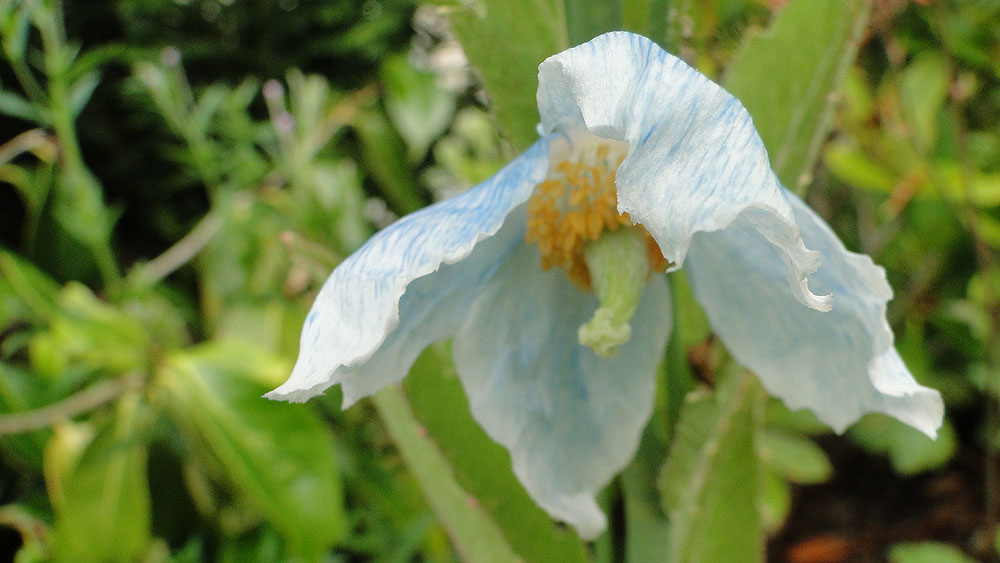
 One of the advantages of writing about Meconopsis in this way is that one makes contact with people. This is a quite exquisite form of Meconopsis betonicifolia (or baileyi if you accept the current split). I planted these seedlings in my daughter in Cumbria's garden where meconopsis thrive. There are 4 plants and all are of this beautiful pastel pale blue. They are throwing side shoots so they should be perennial. These seeds were sent to me by Svetlana from Russia and they are a wonderful addition to my collections.
Sunday, 21 June 2015
In north Caithness I have large planting of various big blue poppies for seed. This is a varition on the tetraploid Lingholm. Blues in Meconopsis can vary from year to year and I suspect temperature is involved. In the north we have had a long cold spring and so far only two pleasantly warm days of summer!

Sunday, 14 June 2015
 Nothing what so ever to do with Meconopsis! Many years ago one of my daughters was working in New Zealand and as always was asked to bring me back interesting seed. It has taken all these years to grow into a tree and flower. It is the Kowhai tree. This is a native legume Sophora tetaptera - the large leaved kowhai. This genus has the reputation in the United Kingdom of not being fully hardy especially when young. It has thrived in our garden near the sea on the east coast of Scotland and the flowers up to 6 cms. long are most spectacular.

Sunday, 7 June 2015
 Total heartbreak. This was a double Meconopsis punicea in the garden. Not sure compared to the true species that it is anything like so attractive - I find many double forms of wild flowers in the garden a bit over flamboyant. Plagued by mice earlier now it was the turn of wood pigeons. The garden is already lush and in good growth with at least 10 species of Meconopsis as rosettes or in flower. On Thursday I did my daily rounds and found every flower, every seed pod and every bud on every single Meconopsis punicea had been eaten by wood pigeons (Columba palumbus). Nothing else was touched and there were 4 separate planting of punicea. Now there will be no seed. I did give plants away to 3 botanic gardens last year so hopefully they have not all been molested by this plague species - totally out of control in the U.K. There was poor germination this year of limited seed but I do have about 40 seedlings but it is having nothing to sow for next years plants that it so sad since it is normally biennial. The only positive thing to come out of this is JUST MAYBE they will either develop new flower buds for later in the summer or perhaps just possibly wait and flower next year.

Tuesday, 2 June 2015

Saturday, 23 May 2015

Many Meconopsis produce albinos and this is the white form of M. horridula (probably the form M. prattii). At least a proportion of any seedlings will be white and in the medium term one can select a plant that breeds true crystaline white.
PLEASE NOTE I HAVE GOT THIS ALL WRONG!
Friends who have traveled widely in the Himalayas and indeed even took me to China to see Meconopsis, say that Meconopsis horridula was broken up by Dr. Grey-Wilson into a number of separate species. These are all quite distinct species and grow in defined locations that are very large distances apart. This is therefore a white form of the species M. prattii. Meconopsis horridula itself has a very wide distribution from west Nepal right up through Tibet and beyond its borders to the north (it is difficult in cultivation in the U.K.). There are a number of subspecies of M. horridula described, as well as the related M. prainiana, pratti. racemosa and zhongdianensis. For any Meconopsis enthusiast there is a most excellent account with comprehensive and brilliantly photographed images in Dr. Grey-Wilson's book THE GENUS MECONOPSIS from page 238. The book was published by Kew Publishing. Royal Botanic Gardens.
I suspect many gardeners however will refer to these plants as 'Meconopsis horridula' as do some major seed lists like those of the Scottish Rock Garden Club. All have really horrid spines which can make seed collecting unpleasant. In the wild there are all shades of blue, pale yellow forms, purple/mauve and pink forms as well as albinos and the anthers vary between bright yellow and white/grey. The spines (very variable) on the leaves may have a purple pigment spot at the base (as does M. rudis in the garden). This like M. prattii is widely established in the U.K. Both are easy probably anywhere and like all this group of plants are usually biennial and monocarpic.
Sunday, 17 May 2015

Meconopsis simplicifolia. This is a photograph taken in the wild by friends in the Himalayas. It does not really do it justice. It is very variable in the wild and it can have really large pale blue flowers that hang down and always single flowers on basal stalks. Dr Grey Wilson in his book on 'Meconopsis' has split it into 2 sub species. M. simplicifolia ssp simplicifolia and M.s. grandiflora. When I cultivated them there was Bailey's form and a host of similar ones. Some were definitely biennial what ever you did but others would at least pretend to be perennial though I always found them difficult and lost them. Probably would be easier in cold northern climates. A good large pale blue form is highly desirable and I would love to have it again. It characteristically has blue filaments to the anthers while M . grandis, with which one could confuse it, has white filaments.
Sunday, 10 May 2015
There are quite a number of named species under the basic title of Meconopsis horridula. These range from a beautiful strong medium blue like this through a whole range of muddy purple to white. They have been split into separate species. M. horridula is a high altitude species and very difficult. This M. racemosa in a nice strong colour. Usually biennial and easy from seed and will grow in hot dry places in poor soil. It is very spiny and harvesting seed from very prickly dry pods needs care! Meconopsis rudis is much the same and putting these spiny blue plants into the right species is not easy. Grow from which ever seed is offered to you and then select seeds for yourself and to share with others from the best colour and growth of forms.

Sunday, 3 May 2015
 Meconopsis quintuplinervia. Perhaps the most delicate of all the Meconopsis - the harebell poppy. There are at least two forms of this in cultivation which are obviously different. Both have the virtue of being very perennial and easily divided and probably as easy as any of this genera to cultivate.
Sunday, 26 April 2015
 I have been waiting for my first Meconopsis punicea to flower - buds just opening - when my eldest daughter in Wick, Caithness sent me this image of Lingholm already in flower! Caithness in the very far north of Scotland can have warmer weather than one might imagine due to the proximity of the North Atlantic drift passing across the top of the mainland and then coming north - south down the North Sea.
Sunday, 19 April 2015
Meconopsis punicea. My absolute favorite Meconopsis. Many years ago when I wrote my book on Meconopsis I was rather horrified that the publisher had used this species as the jacket cover. I felt this was inappropriate for a book on 'BLUE POPPIES.' Just why this wonderful species has red flowers will almost certainly be related to what originally pollinated it. The bottom image here shows the problem since it is not clear how insects would be guided to pollinate it. Red tubular flowers in some parts of the world are pollinated by humming birds and these are often long tubular flowers that the long tongues of humming birds can reach and other insects pollinators cannot. I do have to add that on really hot days M. punicea does open up a little and bees and the like could pollinate it. It is possible that blue Meconopsis evolved from red ones.

The top image is of a plant in the garden of Carol and Hugh who live just up the road. The buds on this plant are twice the size of any plant of this species I have ever seen. I cannot wait to see it flower! I might add that Carol is very green fingered and she has produced big surpluses of this species which we have been able to give back to various gardens open to the public such as Branklyn in Perth. The main website gives information on growing this plant on from seed.
Saturday, 11 April 2015
Meconopsis prainiana and also M. prattii. These are the spiny blue poppies related to Meconopsis horridula. Across the whole Himalayan range there must be great variation. They can be perfect azure blue through light blue in one direction and into muddy shades of purple in the other. There are white forms in cultivation too and even suggestions of yellow forms. What is in the seed exchanges is pretty variable and may not always turn out to be a good clear colour form. They are easy from seed and grow on quickly and usually they will flower as a biennial but can take an extra year especially in thin dry soils. With more than one plant they should set plenty of seed even in a poor year. Harvesting the seeds might best be done with gloves since the spines are strong and almost unpleasant to the touch. This plant again should grow anywhere in the U.K., even in hot dry climates, as long as the seedlings are grown with care in more moist controlled situations.

Subscribe to:
Posts (Atom)